Introduction
The literal word “Nakshatra” means “The one who cannot be destroyed”. Ancient Indians had long observed the movement of planets, planets dimmed and brightened with their cycles around the sun. They are the players of Vedic Astrology. But as important are the players, one cannot mistake the importance of the canvas itself. The underlying surface of the celestial sphere as seen from the earth. The ancients believed, the stars are stable, they never move, they are indestructible (We now know both to be untrue). Nakshatras were created as small star group structures. They wouldn’t fit the modern concept of constellations, asterism is a more correct word to describe them in English. They are the perfect backdrop for the dance of the planets. They provide context to planetary movements, they provide nuanced meaning to every single space on the celestial sphere, upon which the planets act. The immortal ones who forever will hold their place.
Historical Background
Nakshatras are a purely Indic concepts. After Alexander’s India invasion, a lot of Greek thoughts and concepts were imported into India (12 signs for example), but the Nakshatras predate all. They were the original way Indian people, pre-Greek influence would divide the celestial sphere in. The concept of Nakshatra first appears in Vedanga Jyotish. It has no predictive function in this text. It is a time keeping book used as a Lunisolar calendar. Assuming the stars are fixed and the calendar accommodates the differences between the lunar and the solar calendar, one can predict exactly where the sun and the moon will be, in respect to the celestial sphere. In layman’s terms, the stars and their clusters were used as landmarks for the planets’ journey across the visible sky.
One of the four basic books of Hinduism, Atharvaved has descriptions of nakshatras. Below is an excerpt from Atharvaved (Hymns of Atharvaved by Ralph T. H. Griffith). The Hymn is a prayer to 28 Lunar mansions. You will notice the Hymn doesn’t start with Ashwini (0 degree Aries), it’s because in ancient times, the Kritika-Chitra axis was the start of the celestial sphere.
A Prayer to the Lunar Mansions and other Powers for protection and prosperity
1 The brilliant lights shining in heaven together, which through
the world glide on with rapid motion.
And Days, and Firmament with songs I worship, seeking the
Twenty-eight-fold for its favour.
2 Krittikās, Rohinī be swift to hear me! Let Mrigasiras bless me,
help me Ārdrā!
Punarvasu and Sūnritā, fair Pushya, the Sun, Asleshās, Maghā
lead me onward!
3 My bliss be Svāti and benignant Chitrā, my right First Phalgunis
and present Hasta.
Rādhas, Visākhas, gracious Anurādhā, Jyeshthā and happy-
starred uninjured Mūla.
4 Food shall be earlier Ashādhas grant me; let those that follow
bring me strength and vigour;
With virtuous merit Abhijit endow me! Sravana and Sravishthās
make me prosper.
5 Satabhishak afford me ample freedom, and both the Proshtha-
padas guard me safely.
Revati and the Asvayujas bring me luck, and the Bharanis
abundant riches!
List of Nakshatras
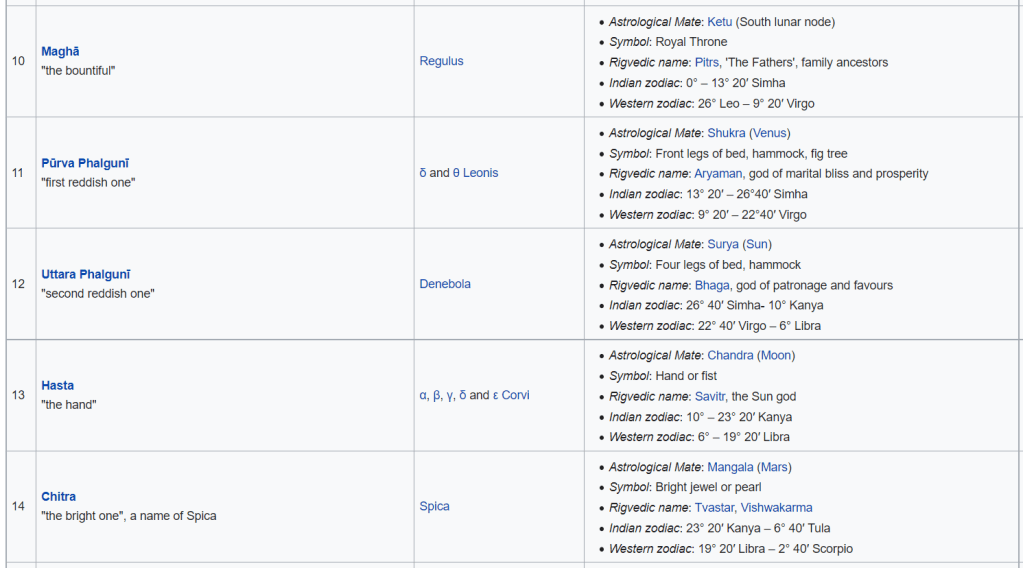
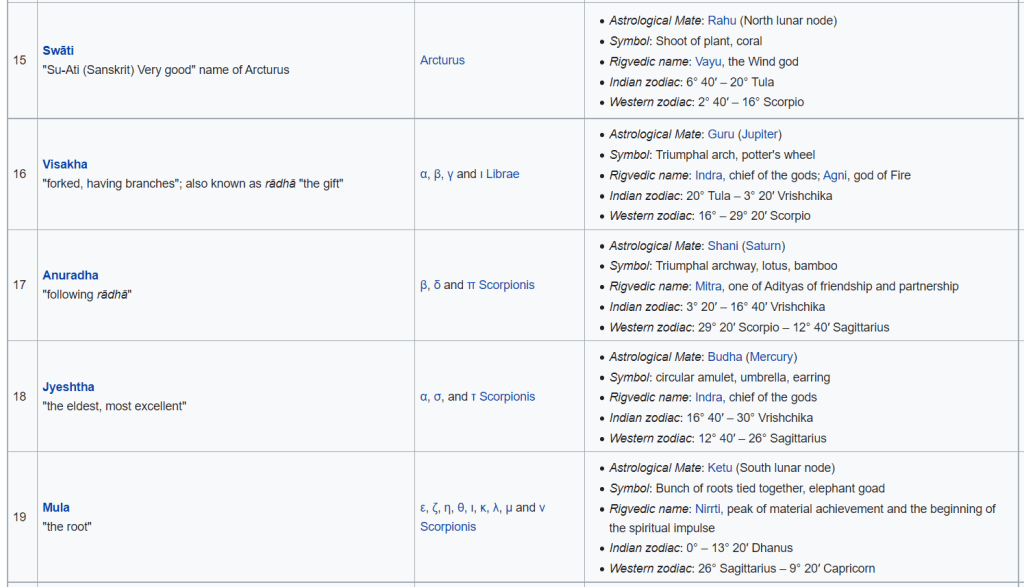
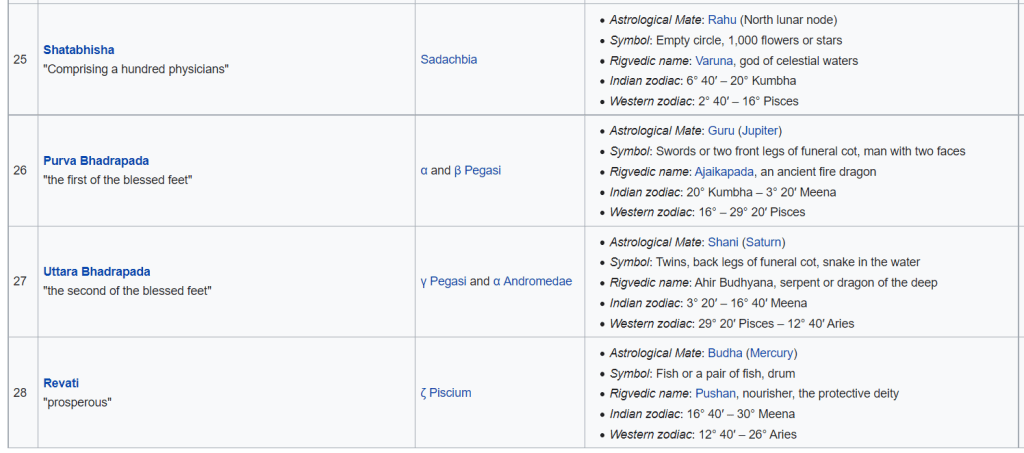
So now we come to a list of Nakshatras. Surprisingly, the most detailed list and description I found was on Wikipedia. It not only lists them and their characteristics, but also their place in the Vedic sky and today’s sky. Remember the difference between the skies is due to Ayanāṃśa. You can refer to my article of Ayanāṃśa for more clarification. Below is from the Wikipedia article for Nakshatra.



Importance in predictive Vedic Astrology
So all this information is well and good, but how do we actually use these mansions in actual predictive Astrology? For first things, there are many more than 12 signs. Each nakshatra has a ruling planet (Or “Astrological Mate” as Wikipedia has it), has a type, Rakshas, Dev, Manushya (Demon, Demigod and Human) and has certain innate characteristics. All of these attributes can be combined with the planet in the Nakshatra to give a much more targeted and nuanced approach to Vedic Astrology. Furthermore each Nakshatra (The 27 remaining ones) are divided into 4 parts which align perfectly with the Navmas (One ninth part of a zodiac) creating a very synergetic relationship to the chart.
The lost one: Abhijit
So you will notice that the list has 28 Nakshatras but the calculation for the celestial sphere only has 27. This is a short story of the lost Nakshatra Abhijit. Abhijit is no longer used as a Nakshatra in the celestial sphere calculations used for predictive Astrology. It is still used in intercalary (Time keeping) astrology. It corresponds to the the star Vega. It is heavily used to find auspicious times for important events. Moon in Abhijit is considered to be a very auspicious time.
In Conclusion
I hope this short article has given you a brief overview of the wonderful world of Nakshatras. I intend to write a series of articles for each Nakshatra and add in effects they have on all planets. When complete, I would like it to be a complete anthology of everything Nakshatra, a tribute to these delightful lunar mansions of the ancient world.
 MicroJyotishi