
Introduction
One of the most common question that is asked of a Vedic astrologer is about the difference between current western astrology (Also called “Tropical astrology”) and Vedic astrology. This blog post is going to be an exposition on the differences. There is a little history (As always), a little mathematics and a lot of astronomy to guide us through the difference between these two.
Heliocentrism Vs Geocentrism
It is now an established fact that our sun is an average star in an average galaxy. We live on a planet that revolves around this star. This seemingly irrefutable fact of life wasn’t always so. For a lot of history, we as a human race saw astronomy (And by extension astrology) through a very different model. The model which stated that earth is the center of the universe and all other celestial bodies move around it. This is called Geocentrism. This was proved wrong by Copernicus and astronomy significantly diverges from astrology from then. The current model that we use is called Heliocentrism, which puts the sun as the barycenter of the solar system.
Geocentric model and the background of stars
Now that we understand what the geocentric model is, the next step is to understand how it works practically. The earth moves around the sun, the moon moves around the earth, planets move around in the same sun at different speeds and different distances. So how does this look from the earth. The relative motion of the planets in respect to earth is different than a straightforward heliocentric motion of planets around the sun. In such a setting a planet can go backwards (Or at least appear to). If this is confusing, consider a simple physics example. There are two cars driving near about the same speed next to each other. One of them slows down. If you look from above you still see two cars racing in the same direction. However if you are sitting in the faster car, the slower car appears to go backwards away from your car. This is a simplistic example, but a good place to start to understand geocentric model. Below diagram from Wikipedia does a good job of explaining this.
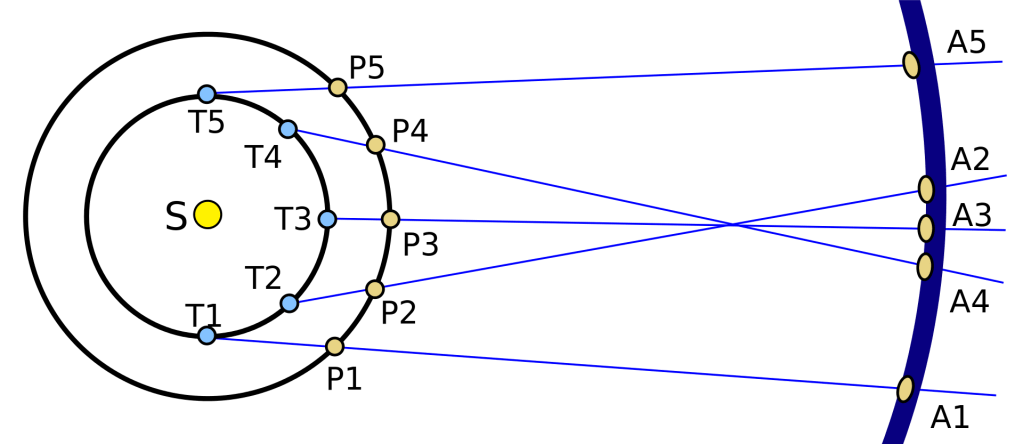
T1, T2, …, T5 – positions of Earth
P1, P2, …, P5 – positions of a planet
A1, A2, …, A5 – projection to celestial sphere
By Rursus – Own work, CC BY-SA 3.0, https://commons.wikimedia.org/w/index.php?curid=7119751
I do not want to turn this post into a geocentric model research paper, so will leave it at that. If any readers are interested in more reading material, will be glad to point them in correction direction. I am intending to write a more detailed post about geocentric retrogradation and it’s astrological impacts.
Historically speaking, the geocentric model was used by a lot of cultures. Both Vedic and Hellenistic astronomers had correctly charted the paths of the five planets (Plus moon and the sun) on the background of the celestial sphere. Their observations pointed to a stable, predictable motion of these planets against the backdrop of a constant background of stars. Stars they said, never moved, they could not be destroyed, they are the benchmark from where to measure planets. They were called Nakshatra, the “Ones who cannot be destroyed or changed”. Stars were the perfect background, never changing, but were they?
Equinoxes shifts
We now know that the earth is titled on an axis when it rotates around it. This causes the seasons in higher altitudes of each hemisphere. As it spins, every now and then it wobbles. If you ever had the chance to observe a child’s toy top spinning, you would’ve noticed its cyclically wobbling, the same thing happens to earth. This is called the precession of equinoxes. This is a cyclical 25,772 year motion of the earth. So how do equinoxes come into picture here and how does this affect the stars? While the ancient astronomers were more or less correct that the stars don’t change much (Stars can die in supernovae and change light intensity) over smaller periods of time, they did not realize how the earth’s wobble affects the sky they see and changes the apparent position of the stars. This is more apparent when we use the equinoxes, as evident in diagram below. There is a lot of calculations involved, but in the end the number is 50.3 second shift every solar year.
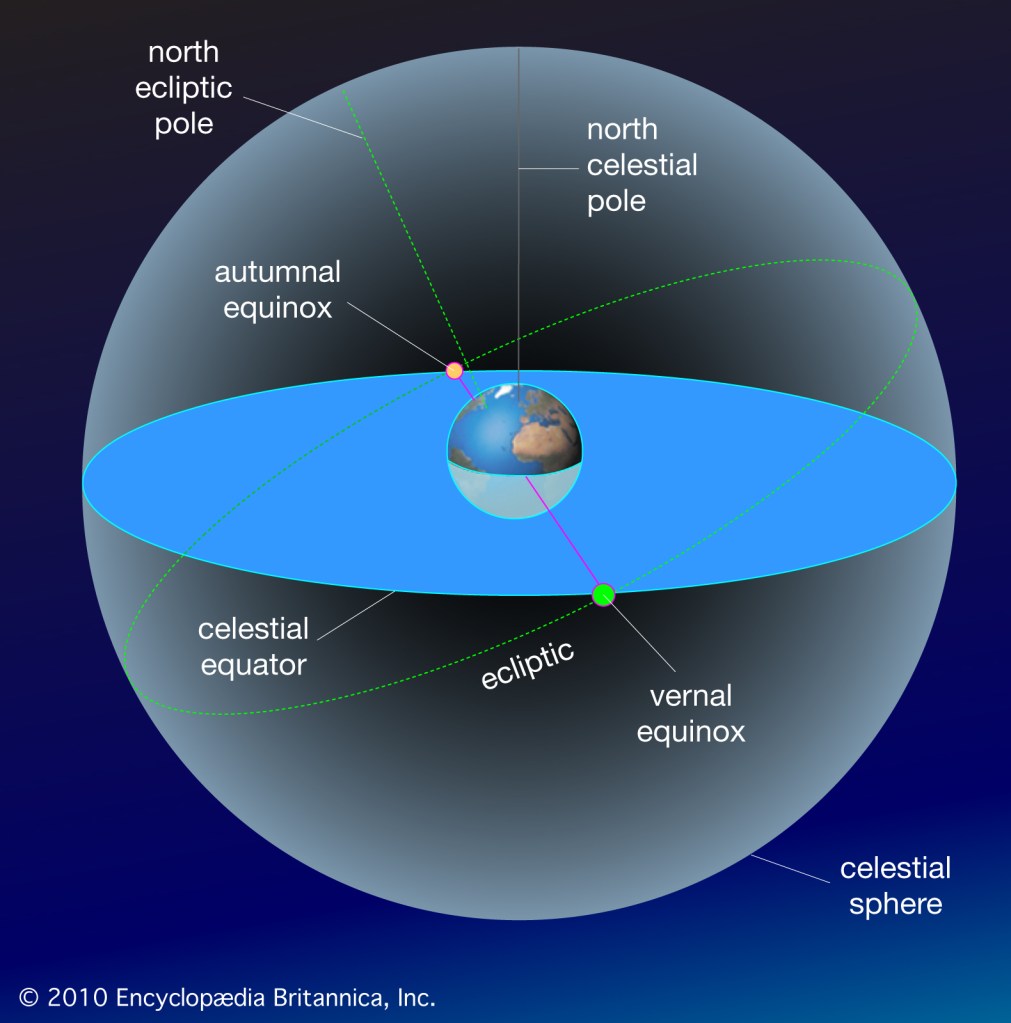
As a result of this slight wobble, the stars appear to shift and nowadays we can see the equinoxes drift backwards in our adjusted solar calendar.
Ayanāṃśa : What is it?
To discredit the Hellenistic and Indian astronomers of being totally oblivious of equinox shift would be a wrong statement. They knew the stars weren’t perfectly stable, they just never seemed to have figured out that earth’s wobble might be the cause of it. Surya Siddhanta (lit. “Principles of the sun”) is a c. 600 – 800 CE text that is remarkable accurate about a lot of astronomical things. This is also the first book to explicitly mention an Ayanāṃśa. An Ayanāṃśa (lit. “part of movement”) is an adjustment made during calculations to account for the Equinox shift. Over the millennia, while the earth wobbled away freely, the sky has changed. For every year the sky has shifted 50.3 seconds, totally changing from how it looked while all the great astrology books were written. To use our ancient books we need to revert back to what the astrologers saw back in the day. We do this by subtracting a value from all current astrological readings, in effect placing our birth charts on an ancient sky background. This value that we subtract is called Ayanāṃśa.
Ayanāṃśa : How much to subtract?
If you have been following the math all along, you will probably have realized that the amount to subtract depends on how far behind in time do you want to go. So how much do we subtract? We are not sure. There are a lot of opinions around it. The number to subtract varies between 22 to 24 degrees. Below is the most common used for calculation, this is the one I use for all my calculations.
Chitrapaksha Ayanāṃśa
When the sun’s ecliptic path crosses from the south to north and meets celestial equator at the vernal equinox, which is the first point of Aries (0.0.0 Aries), this point is not fixed and equinox moves westward with reference to a fixed star. In this system this star is fixed with star called Spica, which is 180° away from the Vedic 0.0.0 Aries point. The difference between this fixed point and vernal equinox is known as Chitrapaksha Ayanāṃśa. Spica is part of the Vedic lunar nakshatra called “Chitra”, hence the name. As of 2021 the value is 24.9.14 (24 degrees, 9 minutes and 14 seconds). Remember this value increases by 50.3 seconds every year. So add 50.3 seconds for each year after 2021, if you are reading this in the future. Remember this is radial arithmetic, so 60 seconds = 1 minute and 60 minutes = 1 degree.
Difference with western astrology
Modern western astrology is a rejuvenation of the Hellenistic astrology of Ptolemy. This system doesn’t use Ayanāṃśa corrections. So in effect, western charts look exactly like the sky when a child was born. A vedic chart will have the Ayanāṃśa correction depending on what year the child was born. For child born now, all planets in Vedic chart will be 24 degrees behind the western chart. So how does it matter with predictions? Modern western astrology while based on Hellenistic astrology, is mostly a 20th century invention. The attributes attributed to planets are mostly modern interpretations mixed a lot with pseudo-psychology. There is the further issue of the moving goal posts. Every year the underlying chart in western astrology moved 50.3 seconds, so if a person was born long ago enough, the chart has moved. In case of planets that are close between houses, the planet would be moved to next house totally changing the prediction. So are you going to give a different prediction for the same planet just 60 years apart? In my opinion having a stable frame of reference, like in Vedic astrology greatly reduces such dilemmas.
In conclusion
Hopefully this blog post helped you to understand a few basic astronomical and astrological phenomenon. Astrology is a divination art. It is backed by a lot of astronomy and mathematics, but the actual divination part of subjective and hence cannot be classified as a science. Furthermore it is dependent on the biases of the astrologer. It is up to the client to choose what to believe in. So, whether to believe in western astrology or Vedic astrology is a personal decision, which no one should be derided for.

 MicroJyotishi
One thought on “Ayanāṃśa : Difference between western and Vedic astrology”