Sidereal Jupiter (Vedic Jupiter) has transited into Taurus (Vrushab Raas). It will remain in Taurus for about a year. The unique combination of a Venusian sign combined with a traditionalist and old planet like Jupiter will create some unique situations for all the moon signs. If you are not sure of your Vedic moon sign, you can use some online Vedic chart calculators and find out. Or schedule a call with me for a detailed chart reading.
Aries Moon Sign (Mesh Raas) : Jupiter will be second from your moon. A house of money, prosperity and wealth accumulation. Expect your financial position to improve and savings grow. It is the sign of eyes, so people need to visit their eye doctors especially if you suffer from other Jovian diseases.
Taurus Moon Sign (Vrushabh Raas): Jupiter will be over your natal moon creating a wonderful year. Health will improve, money will flow in and in general a good lucky time. A great time to start an educational enterprise, a new relationship or devote yourself to spiritual pursuit.
Gemini Moon Sign (Mithun Raas): Jupiter will be in the twelfth house. The natural home of Jupiter will give a good resting place for the giant planet. Spiritual and charitable pursuits will happen. Travels are in your future. Money will be spent, but well spent. People with pre-existing Jovian diseases such as diabetes need to monitor their health.
Cancer Moon Sign (Kark Raas): Jupiter will be in your eleventh house. A house of income, fashion, society and superficiality. Income will increase. You will enjoy a good social year with lots of friends, parties and fun. But beware the superficiality of the eleventh. All that shines is not gold.
Leo Moon Sign (Singh Raas): Jupiter transits your tenth. The place of work, businesses and managers. Look out for promotions, kudos and bonuses at work. Hard work of the last year will be rewarded this year. Good time to make that jump for new job.
Virgo Moon Sign (Kanya Raas): Jupiter transits your ninth, throws an aspect on the first. Health improves for all you hypochondriacs. Educational pursuits and self improvement is on the horizon. Good time for children all around.
Libra Moon Sign (Tula Raas): Jupiter goes through your eighth. Generally not considered a good house. Health concerns might arise for family members. Unexpected wealth might be on the horizon, but like everything eighth, a price will be paid. Good time to practice your patience and hang in there.
Scorpio Moon Sign (Vruschik Raas): Jupiter transits through your seventh. What a bonanza for you and your partner. If you are looking for a romantic partner, here is your time. Jump in head first. Any old litigation, pending issues will resolve. Health will improve.
Sagittarius Moon Sign (Dhanu Raas): Jupiter transits through your sixth. Keep an eye out on your health, Jovial headwinds your way. On the good side, a great time for people who are in jobs. Non health luck will follow you for the year. Time to connect with old friends and family.
Capricorn Moon Sign (Makar Raas): Jupiter transits your fifth, a place of education, children and love. So you’ll see improvements in those situations if they apply. Also the place of unexpected money. Anything owed to you will come to you.
Aquarius Moon Sign (Kumbh Raas): Jupiter transits to your fourth. Time to reconnect anew with your mother. Good time to invest in real estate or a vehicle. But don’t forget, Jupiter hates the flashy things so be modest.
Pisces Moon Sign (Meen Raas): Jupiter transits to your third. You will need help and you will get it. Let go of your ego and reach out to people. Small travels for work may come about. Temporary setbacks may be seen for jobs or businesses but you will overcome with some help.
The literal word “Nakshatra” means “The one who cannot be destroyed”. Ancient Indians had long observed the movement of planets, planets dimmed and brightened with their cycles around the sun. They are the players of Vedic Astrology. But as important are the players, one cannot mistake the importance of the canvas itself. The underlying surface of the celestial sphere as seen from the earth. The ancients believed, the stars are stable, they never move, they are indestructible (We now know both to be untrue). Nakshatras were created as small star group structures. They wouldn’t fit the modern concept of constellations, asterism is a more correct word to describe them in English. They are the perfect backdrop for the dance of the planets. They provide context to planetary movements, they provide nuanced meaning to every single space on the celestial sphere, upon which the planets act. The immortal ones who forever will hold their place.
Historical Background
Nakshatras are a purely Indic concepts. After Alexander’s India invasion, a lot of Greek thoughts and concepts were imported into India (12 signs for example), but the Nakshatras predate all. They were the original way Indian people, pre-Greek influence would divide the celestial sphere in. The concept of Nakshatra first appears in Vedanga Jyotish. It has no predictive function in this text. It is a time keeping book used as a Lunisolar calendar. Assuming the stars are fixed and the calendar accommodates the differences between the lunar and the solar calendar, one can predict exactly where the sun and the moon will be, in respect to the celestial sphere. In layman’s terms, the stars and their clusters were used as landmarks for the planets’ journey across the visible sky.
One of the four basic books of Hinduism, Atharvaved has descriptions of nakshatras. Below is an excerpt from Atharvaved (Hymns of Atharvaved by Ralph T. H. Griffith). The Hymn is a prayer to 28 Lunar mansions. You will notice the Hymn doesn’t start with Ashwini (0 degree Aries), it’s because in ancient times, the Kritika-Chitra axis was the start of the celestial sphere.
A Prayer to the Lunar Mansions and other Powers for protection and prosperity
1 The brilliant lights shining in heaven together, which through the world glide on with rapid motion. And Days, and Firmament with songs I worship, seeking the Twenty-eight-fold for its favour. 2 Krittikās, Rohinī be swift to hear me! Let Mrigasiras bless me, help me Ārdrā! Punarvasu and Sūnritā, fair Pushya, the Sun, Asleshās, Maghā lead me onward! 3 My bliss be Svāti and benignant Chitrā, my right First Phalgunis and present Hasta. Rādhas, Visākhas, gracious Anurādhā, Jyeshthā and happy- starred uninjured Mūla. 4 Food shall be earlier Ashādhas grant me; let those that follow bring me strength and vigour; With virtuous merit Abhijit endow me! Sravana and Sravishthās make me prosper. 5 Satabhishak afford me ample freedom, and both the Proshtha- padas guard me safely. Revati and the Asvayujas bring me luck, and the Bharanis abundant riches!
List of Nakshatras
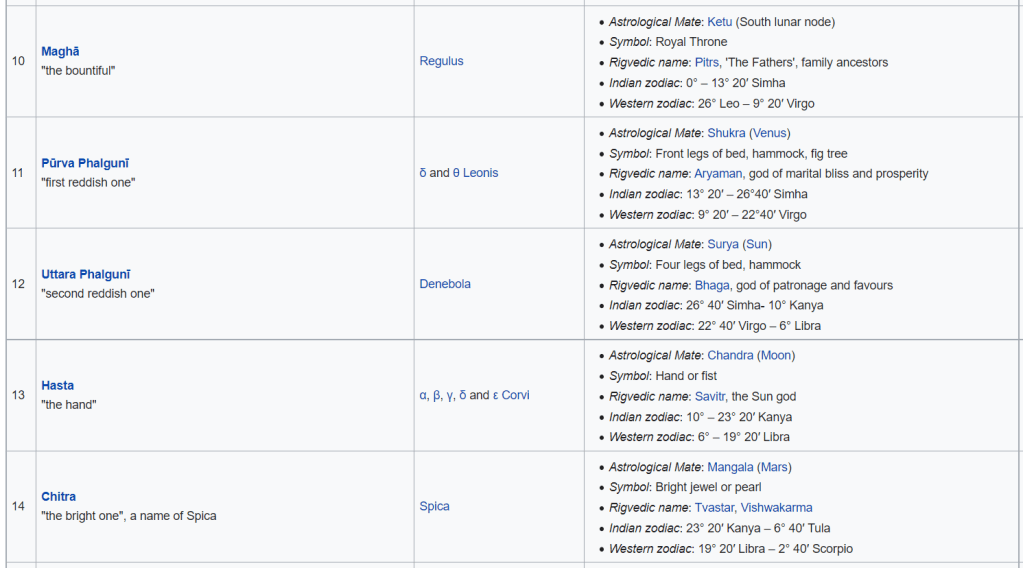
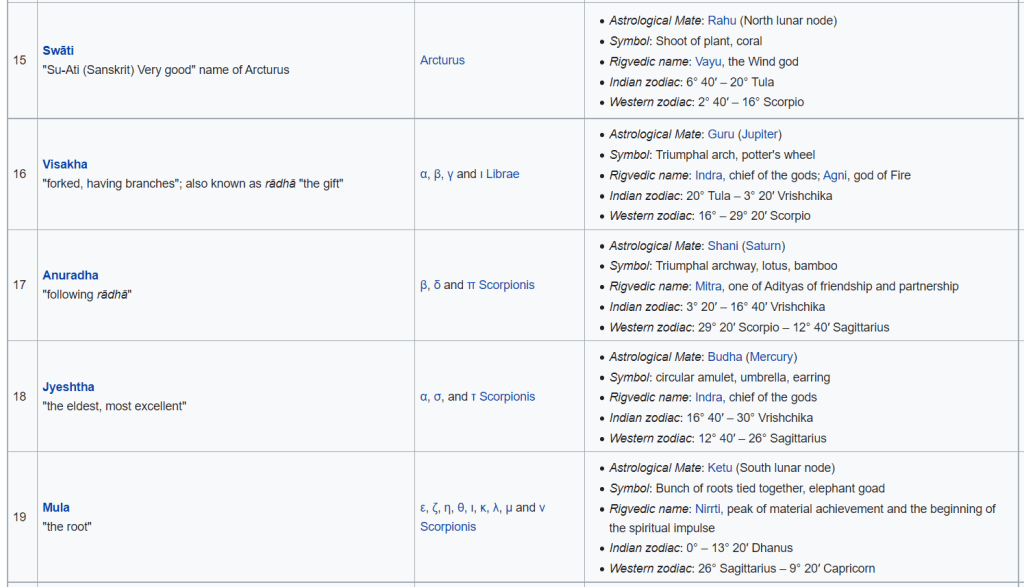
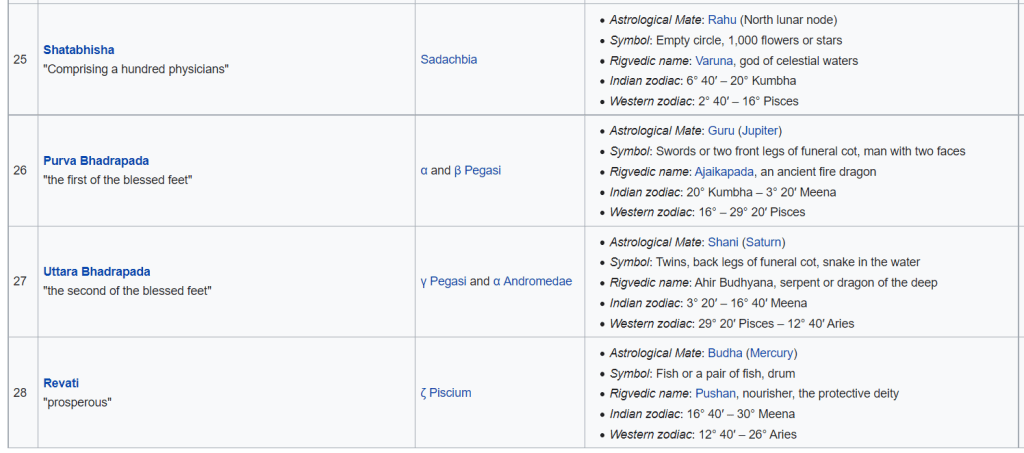
So now we come to a list of Nakshatras. Surprisingly, the most detailed list and description I found was on Wikipedia. It not only lists them and their characteristics, but also their place in the Vedic sky and today’s sky. Remember the difference between the skies is due to Ayanāṃśa. You can refer to my article of Ayanāṃśa for more clarification. Below is from the Wikipedia article for Nakshatra.
Importance in predictive Vedic Astrology
So all this information is well and good, but how do we actually use these mansions in actual predictive Astrology? For first things, there are many more than 12 signs. Each nakshatra has a ruling planet (Or “Astrological Mate” as Wikipedia has it), has a type, Rakshas, Dev, Manushya (Demon, Demigod and Human) and has certain innate characteristics. All of these attributes can be combined with the planet in the Nakshatra to give a much more targeted and nuanced approach to Vedic Astrology. Furthermore each Nakshatra (The 27 remaining ones) are divided into 4 parts which align perfectly with the Navmas (One ninth part of a zodiac) creating a very synergetic relationship to the chart.
The lost one: Abhijit
So you will notice that the list has 28 Nakshatras but the calculation for the celestial sphere only has 27. This is a short story of the lost Nakshatra Abhijit. Abhijit is no longer used as a Nakshatra in the celestial sphere calculations used for predictive Astrology. It is still used in intercalary (Time keeping) astrology. It corresponds to the the star Vega. It is heavily used to find auspicious times for important events. Moon in Abhijit is considered to be a very auspicious time.
In Conclusion
I hope this short article has given you a brief overview of the wonderful world of Nakshatras. I intend to write a series of articles for each Nakshatra and add in effects they have on all planets. When complete, I would like it to be a complete anthology of everything Nakshatra, a tribute to these delightful lunar mansions of the ancient world.
One of the most common question that is asked of a Vedic astrologer is about the difference between current western astrology (Also called “Tropical astrology”) and Vedic astrology. This blog post is going to be an exposition on the differences. There is a little history (As always), a little mathematics and a lot of astronomy to guide us through the difference between these two.
Heliocentrism Vs Geocentrism
It is now an established fact that our sun is an average star in an average galaxy. We live on a planet that revolves around this star. This seemingly irrefutable fact of life wasn’t always so. For a lot of history, we as a human race saw astronomy (And by extension astrology) through a very different model. The model which stated that earth is the center of the universe and all other celestial bodies move around it. This is called Geocentrism. This was proved wrong by Copernicus and astronomy significantly diverges from astrology from then. The current model that we use is called Heliocentrism, which puts the sun as the barycenter of the solar system.
Geocentric model and the background of stars
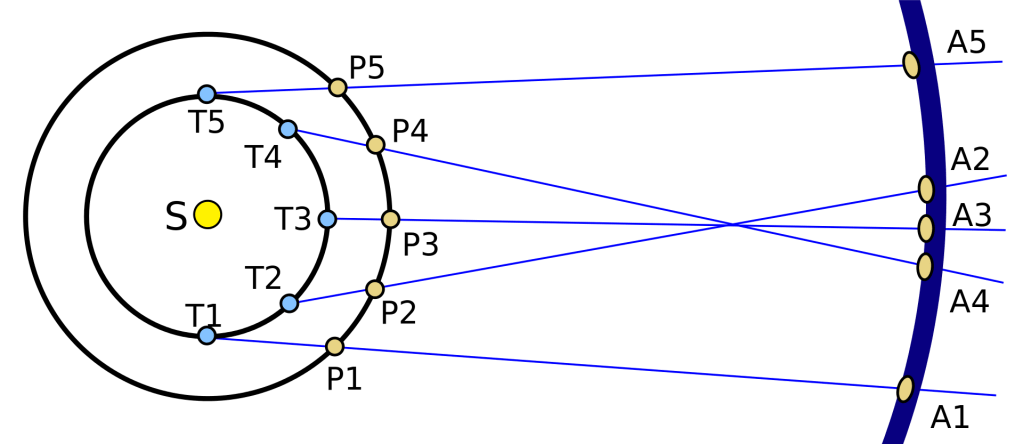
Now that we understand what the geocentric model is, the next step is to understand how it works practically. The earth moves around the sun, the moon moves around the earth, planets move around in the same sun at different speeds and different distances. So how does this look from the earth. The relative motion of the planets in respect to earth is different than a straightforward heliocentric motion of planets around the sun. In such a setting a planet can go backwards (Or at least appear to). If this is confusing, consider a simple physics example. There are two cars driving near about the same speed next to each other. One of them slows down. If you look from above you still see two cars racing in the same direction. However if you are sitting in the faster car, the slower car appears to go backwards away from your car. This is a simplistic example, but a good place to start to understand geocentric model. Below diagram from Wikipedia does a good job of explaining this.
Geocentric retrogradation
T1, T2, …, T5 – positions of Earth P1, P2, …, P5 – positions of a planet A1, A2, …, A5 – projection to celestial sphere
I do not want to turn this post into a geocentric model research paper, so will leave it at that. If any readers are interested in more reading material, will be glad to point them in correction direction. I am intending to write a more detailed post about geocentric retrogradation and it’s astrological impacts.
Historically speaking, the geocentric model was used by a lot of cultures. Both Vedic and Hellenistic astronomers had correctly charted the paths of the five planets (Plus moon and the sun) on the background of the celestial sphere. Their observations pointed to a stable, predictable motion of these planets against the backdrop of a constant background of stars. Stars they said, never moved, they could not be destroyed, they are the benchmark from where to measure planets. They were called Nakshatra, the “Ones who cannot be destroyed or changed”. Stars were the perfect background, never changing, but were they?
Equinoxes shifts
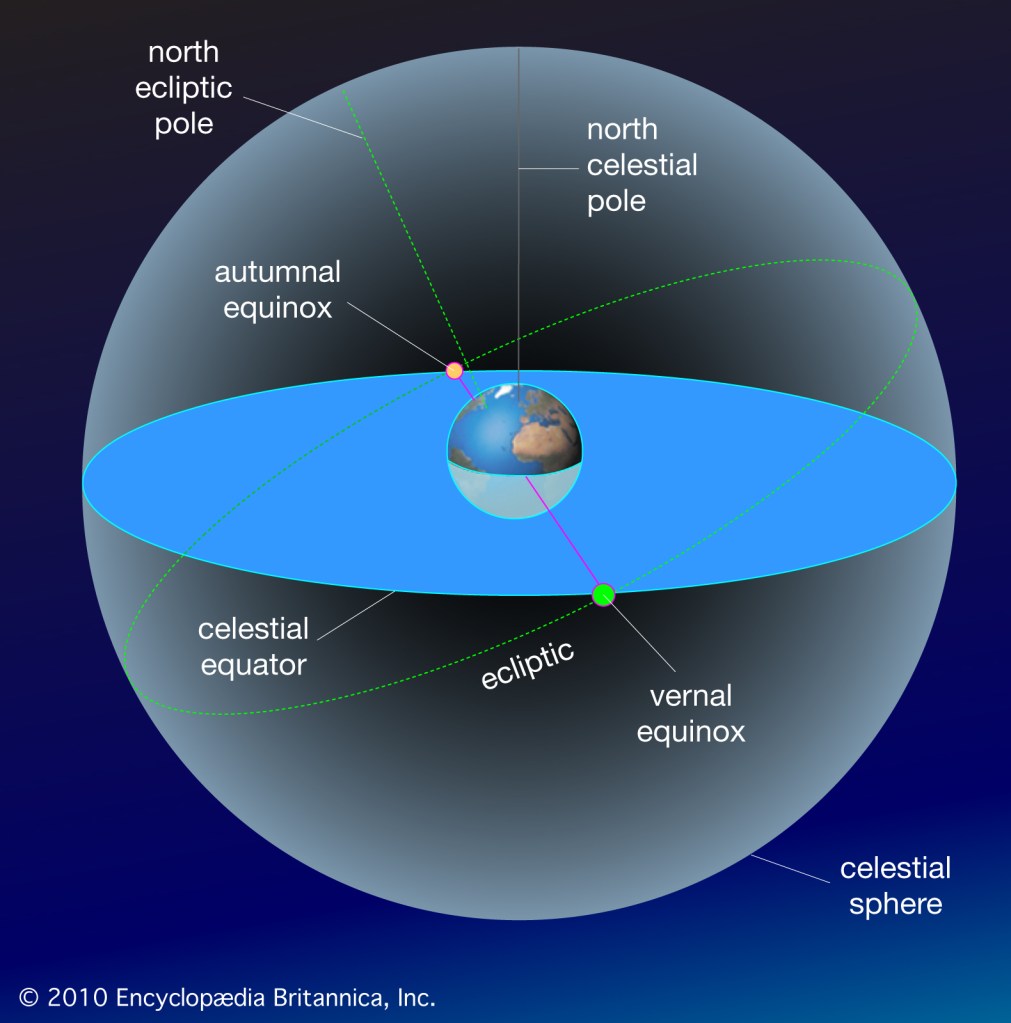
We now know that the earth is titled on an axis when it rotates around it. This causes the seasons in higher altitudes of each hemisphere. As it spins, every now and then it wobbles. If you ever had the chance to observe a child’s toy top spinning, you would’ve noticed its cyclically wobbling, the same thing happens to earth. This is called the precession of equinoxes. This is a cyclical 25,772 year motion of the earth. So how do equinoxes come into picture here and how does this affect the stars? While the ancient astronomers were more or less correct that the stars don’t change much (Stars can die in supernovae and change light intensity) over smaller periods of time, they did not realize how the earth’s wobble affects the sky they see and changes the apparent position of the stars. This is more apparent when we use the equinoxes, as evident in diagram below. There is a lot of calculations involved, but in the end the number is 50.3 second shift every solar year.
As a result of this slight wobble, the stars appear to shift and nowadays we can see the equinoxes drift backwards in our adjusted solar calendar.
Ayanāṃśa : What is it?
To discredit the Hellenistic and Indian astronomers of being totally oblivious of equinox shift would be a wrong statement. They knew the stars weren’t perfectly stable, they just never seemed to have figured out that earth’s wobble might be the cause of it. Surya Siddhanta (lit. “Principles of the sun”) is a c. 600 – 800 CE text that is remarkable accurate about a lot of astronomical things. This is also the first book to explicitly mention an Ayanāṃśa. An Ayanāṃśa (lit. “part of movement”) is an adjustment made during calculations to account for the Equinox shift. Over the millennia, while the earth wobbled away freely, the sky has changed. For every year the sky has shifted 50.3 seconds, totally changing from how it looked while all the great astrology books were written. To use our ancient books we need to revert back to what the astrologers saw back in the day. We do this by subtracting a value from all current astrological readings, in effect placing our birth charts on an ancient sky background. This value that we subtract is called Ayanāṃśa.
Ayanāṃśa : How much to subtract?
If you have been following the math all along, you will probably have realized that the amount to subtract depends on how far behind in time do you want to go. So how much do we subtract? We are not sure. There are a lot of opinions around it. The number to subtract varies between 22 to 24 degrees. Below is the most common used for calculation, this is the one I use for all my calculations.
Chitrapaksha Ayanāṃśa
When the sun’s ecliptic path crosses from the south to north and meets celestial equator at the vernal equinox, which is the first point of Aries (0.0.0 Aries), this point is not fixed and equinox moves westward with reference to a fixed star. In this system this star is fixed with star called Spica, which is 180° away from the Vedic 0.0.0 Aries point. The difference between this fixed point and vernal equinox is known as Chitrapaksha Ayanāṃśa. Spica is part of the Vedic lunar nakshatra called “Chitra”, hence the name. As of 2021 the value is 24.9.14 (24 degrees, 9 minutes and 14 seconds). Remember this value increases by 50.3 seconds every year. So add 50.3 seconds for each year after 2021, if you are reading this in the future. Remember this is radial arithmetic, so 60 seconds = 1 minute and 60 minutes = 1 degree.
Difference with western astrology
Modern western astrology is a rejuvenation of the Hellenistic astrology of Ptolemy. This system doesn’t use Ayanāṃśa corrections. So in effect, western charts look exactly like the sky when a child was born. A vedic chart will have the Ayanāṃśa correction depending on what year the child was born. For child born now, all planets in Vedic chart will be 24 degrees behind the western chart. So how does it matter with predictions? Modern western astrology while based on Hellenistic astrology, is mostly a 20th century invention. The attributes attributed to planets are mostly modern interpretations mixed a lot with pseudo-psychology. There is the further issue of the moving goal posts. Every year the underlying chart in western astrology moved 50.3 seconds, so if a person was born long ago enough, the chart has moved. In case of planets that are close between houses, the planet would be moved to next house totally changing the prediction. So are you going to give a different prediction for the same planet just 60 years apart? In my opinion having a stable frame of reference, like in Vedic astrology greatly reduces such dilemmas.
In conclusion
Hopefully this blog post helped you to understand a few basic astronomical and astrological phenomenon. Astrology is a divination art. It is backed by a lot of astronomy and mathematics, but the actual divination part of subjective and hence cannot be classified as a science. Furthermore it is dependent on the biases of the astrologer. It is up to the client to choose what to believe in. So, whether to believe in western astrology or Vedic astrology is a personal decision, which no one should be derided for.
For five hundred years after Yavanjatakam, we see a plethora of informative astronomical, mathematical and astrological texts. This was the golden age of not only Vedic astrology but for the sciences of astronomy and astrophysics. Below are some of the major people and books that contributed a big deal to this golden age. While immensely interesting, it is not a a thorough list or a thorough writings on each section. While wanting to let the readers know of these works, it is not my aim to write a lot about each of them for sake of succinctness. If any of you want more information about any of these, please let me know in comments and I’ll write separate articles.
Varahmihir
Varahmihir (c. 505 to c. 587 CE) is referred to as the “Father of Vedic astrology”. Varahmihir is credited with normalizing the twelve signs – twelve houses – twelve planets format of Vedic astrology. The Greek influence crystalized into and amalgamated into Vedic astrology by the time Varahmihir breathed his last. He was fluent in Greek and held the Greeks in high regard. Indology scholars point out Varahmihir as an important inflection point for Hellenistic influences on a lot of things, one of them being Astrology.
His Brihatjatakam is one of the most complete compilation of Vedic astrology rules. It is to this day, considered the foremost text of Vedic astrology. Assignment of houses with some aspect of life first appears in Brihatjatakam. Following him, his son Prithuyasas continued his work with a supplemental book Hora Sara. Hora Sara is known for it’s detailed explanations of the 4th and 10th houses.
Brihat Parashar Hora Shastra (Last edition c. 750 CE)
Writing about Vedic astrology would be amiss without mentioning this book. Clouded in deep mystery about it’s origin, this book was more a collection of previous knowledge. It is traditionally attributed to be started by the mythical sage Parashar but has been frequently added upon. The latest addition to BPHS references texts by Varahamir. It is frequently thought to be the collective wisdom of number of scholars over 2000 years. It is a must read for any student of Vedic astrology. Astrologers are frequently spotted quoting BPHS for it’s easy, lucid and non coded predictions.
Saravali (c. 800 CE)
Following BPHS, we see another anthology being published by the King Kalyan Varma. It is thought to be a compilation of various Vedic astrology scholars up to that point in time. The structure of the book reveals it’s history. Saravali is unique in it’s giant list of predictions.
Phaladeepika (c. 13th century)
Phaladeepika by Mantreshwar while technically beyond the purported golden age is another radical work on Vedic astrology. It is known for it’s ground breaking work on retrograde planets and their relation of the sign in which they are. It is in direct contrast to earlier works. This is a relatively shorter book than others mentioned before. If someone is interested in reading an ancient Vedic book, this would be a prime candidate to start with.
Uttarakalmitram (c. 17th century)
Uttarakalmitram is another post golden age work. It is simple compilation mainly based on pre Phaladeepika principles. This is another book for an easy read for a beginner.
Decline
Towards the the end of 13th century, most of India was ruled by various Muslim dynasties originally from what is currently Afghanistan/Iran. To varying degrees these rulers clamped down on Hinduism. Astrology in particular took a hit as a divination art, was considered especially evil. This is also the same time, Hinduism itself was getting very rigid in its caste structure. Brahmins, the original caretakers of ancient knowledge, slowly started becoming insular. Instead of spreading this knowledge, they tried to hoard this knowledge from the general populace. This is the time when most of northern India has started developing new regional languages (derivates of Sanskrit). Sanskrit is not the main language of day-to-day transactions. All of these books written in Sanskrit slowly become inaccessible, confined to the Sanskrit reading Brahmin community. Towards the end of 16th century we see a complete decline in any new ideas of Vedic astrology. Following Uttarakalmitram, there is no new interest or rethinking in Vedic astrology. Immediately following the collapse of Mughal Empire, Hinduism saw a reemergence but unfortunately there was no corelating Vedic astrology interest in this brief post Mughal – Pre British rule. For the next two hundred years, the British Raj had direct or indirect control of most of India. While the British themselves tried to not interfere in the religions of the sub continent, they also tried to impose western white-centric education on Indians. Hinduism as whole was portrayed as an ancient, barbaric practice that can be tolerated but definitely was not to be encouraged. All through these times, Vedic astrology while stagnant was consistently practiced. The priests still made charts, they still fixed marriages, they predicted future events but they were relegated to a vernacular, non elite positions. Vedic astrology (Like broader Hinduism) survived but lost it’s respected position. Through foreign invaders and selfish pedagogues , it had lost the light which it was named after.
Revival
In short, India’s independence was the pivotal event that allowed a revival of Vedic astrology. Even before India’s independence from Britain, various Indology scholars (Both ethnic Indians and western) had started to show interest in Vedic astrology. Though clouded in orientalism and exoticism, a lot of western Indologist were recognizing the ancient Indian works in astronomy, mathematics, sciences etc.
During the early part of the 20th century, we see books being published that collate and reframe the ancient texts for a rapidly modernizing world. The Lal Kitab was formally published in 1939 but was in use in some form since 1898. This is a very modern view on the concepts and references which were now more than a thousand years old.
But it is the independence from Britain in 1947 which is the focal point of an explosion in research. This period also corelated with a reemergence of astrology in the west. During this time, interest in India and ancient Indian culture also sees an increase by both ethnic Indians themselves and by westerners. National pride in ancestors achievements take focus in an India emerging from colonialism. Daily horoscopes in newspapers popularized astrology in general. Towards the end of 20th century, the internet equalized the world. What was once the purview of a select few became available for everyone. It is now a growing field with people contributing to it from all over the world. Hundreds of books and millions of videos are now available devoted to this art of divination.
Right now Vedic astrology is for everyone. It is no longer just for Indians, it is a human art. Anyone, irrespective of their origins or location can benefit from this art. Modern computers allow chart calculations to be done in seconds for anyone born anywhere on the earth. Today’s Vedic astrologers adapt to this ever changing world. We see the past scriptures and focus them to the present. We bring Varahmihir to the digital age and see people’s future. We as Vedic astrologers, stand on the shoulders of who came before us and we shine this light for all to see into their futures.
Ever since the advent of consciousness, mankind has had an innate inquisitiveness about them. The desire to understand why things are happening and to control their future occurrences is as old as history itself. The power to look into the future and divine that-which-hasn’t-happened is an ability that many civilizations in history have tried to achieve. The planets in our solar system and the backdrop of the stars behind them has been a favorite way to look at the future. In this exposition, we take a look at one such system of divination, the Vedic astrology system.
In the beginning…
The very beginning of Vedic astrology can be traced to a book called Vedanga Jyotish. It was one of the six Anga (bodies) incorporated in the Rigved. Written in early Sanskrit, Rigved itself the oldest extant book of any child of the Proto-Indo-European language. Jyotish in literal translation means “Light” (From the Sanskrit root Jyoti). But if you open up Vedang Jyotish and expect to see language about divination, you’ll be disappointed. Vedang Jyotish, while remarkable for its time was mostly a timekeeping operation. In the broadest sense it is a calendar, though it adds a lot more than just months. Hidden in this mundane timekeeping, is the seed of astrology. This is the first book to mention Nakshatra, the first indication that people were using stars as their references. The idea that stars are stable and planets move around their backdrop is the central theme to any astrology discourse. While we no longer need the timekeeping described in Vedanga Jyotish, it remains a relic of the ingenuity of the ancient Indians.
The Vedic period
What started from Vedanga Jyotish continued for almost a thousand years. There is a lot of Indology scholarly work on Vedanga Jyotish to date the text. Results vary from 1200 BCE to as early as 300 BCE. Whether this is a standalone book or was an anthology of other literature of that period is also open to interpretation by scholars. What we know for certain is this remains the only text related to what we now call astrology. There were other books which reference the terms used in Vedanga Jyotish. One likes to think that when 300 BCE came along, the ancient Indians were already using constellations to divine the future, but unfortunately if such books were written they are now lost to time.
Clash of the civilizations
The reason, the decades before 300 BCE are important is because of something completely unrelated to astrology. History through its multi pronged approach touches a lot more than what’s apparent when its happening. In the spring of 327 BCE Alexander the great began his expedition into India. By July, he had conquered the Gandhara kingdom, the Taxila kingdom and routed king Porus at the river Hyphasis (Modern day parts of eastern Iran, Afghanistan and central Pakistan). Faced with the prospects of invading heavily armed empires of the Gangetic plains, Alexander’s army mutinied and he turned back. On his way out he installed satraps, more or less local governors ruling in his name. Alexander died a few years later on his way back to Macedonia. His satraps more or less held on to power towards the end of the century. By 303 BCE the satraps fell and the territory was once again in hands of Indian kings.
So what was the point of that history lesson? Alexanders little incursion into India and the resulting 20+ years of occupation was the focal point of one of the greatest knowledge sharing periods for the ancient civilizations. Hellenistic astrology had developed independently of Vedic astrology. This knowledge sharing brought a realization to both civilizations of what they had independently achieved. Both Hellenistic and Vedic systems had identified the first five planets, they had identified the relative stability of the stars, used moon to keep a calendar and invented methods to adjust it to a solar year. Scholars from both sides, seeing each others as equals shared ideas, thoughts and their empirical observations leading to the creation of modern Vedic astrology.
The Greeks
Centuries following Alexander established a regular trading route from India to eastern Europe facilitating a free flow of scholars and knowledge. We already know Indians were using the Nakshatras to divide the ecliptic into 28 (Later 27) parts. They now added on the twelve signs on top of these Nakshatras to create the first roadmap of modern Indian astrology. The twelve signs of astrology (tropical or Vedic) are a result of this Indo-Hellenistic knowledge sharing. What the Greek side learned from Indians is now lost to history. A lot of it destroyed with the collapse of the library at Alexandria in Egypt.
The earliest known Greek influence on Vedic astrology is a book now lost to history, Yavanjatakam. Written by a person happily known as just Yavaneshwara, the name of the book translates to “Ways of the Greek” (Yavan literally means “invaders” i.e. Greeks). Parts of the book referenced in later books is the reason we know the existence and contents of this long lost book. This is said to be the first western influenced book of Vedic astrology. Following Yavanjatakam, we see a string of book influenced by Hellenistic astrology like Paulisa Siddhant (“Principles of Paul”) – influenced by Paul of Alexandria and Romanka Siddhant (“Principles of the Romans”) – influenced by the Byzantine empire’s astrology. Through these books we see the influence of Greco-Byzantines on the Vedic astrology. The source of these books, the knowledge of astrology of the ancient Greeks and Byzantines remains incomplete, as a lot was lost when Byzantine empire fell to the Ottomans in 1453 CE.
The Golden Age
Five hundred or so years following the first book Yavanjatakam, we see an explosion of Vedic astrology research. This is truly the golden age of Vedic astrology. This is the coming of age of Vedic astrology. By the end of this time, the rules of astrology will have been formalized and the twelve signs, initially just a blip of Greek influence are truly incorporated in the ways of Vedic astrology. This age is characterized by a string of scholars who expounded on the mathematical and the divination aspect of Vedic astrology. Scholars like Varahmihir, Parashar, Mantreshwar wrote volumes upon volumes dedicated to the art of divination. This is where the true delineation between the mathematics, the time keeping and the divination occurs, resulting in creation of a whole new branch of Vedic astrology called Phala shatra. This is the true essence of what we now know as Vedic astrology.
In the next blog post, I will write more on this golden age of Vedic astrology.



 MicroJyotishi